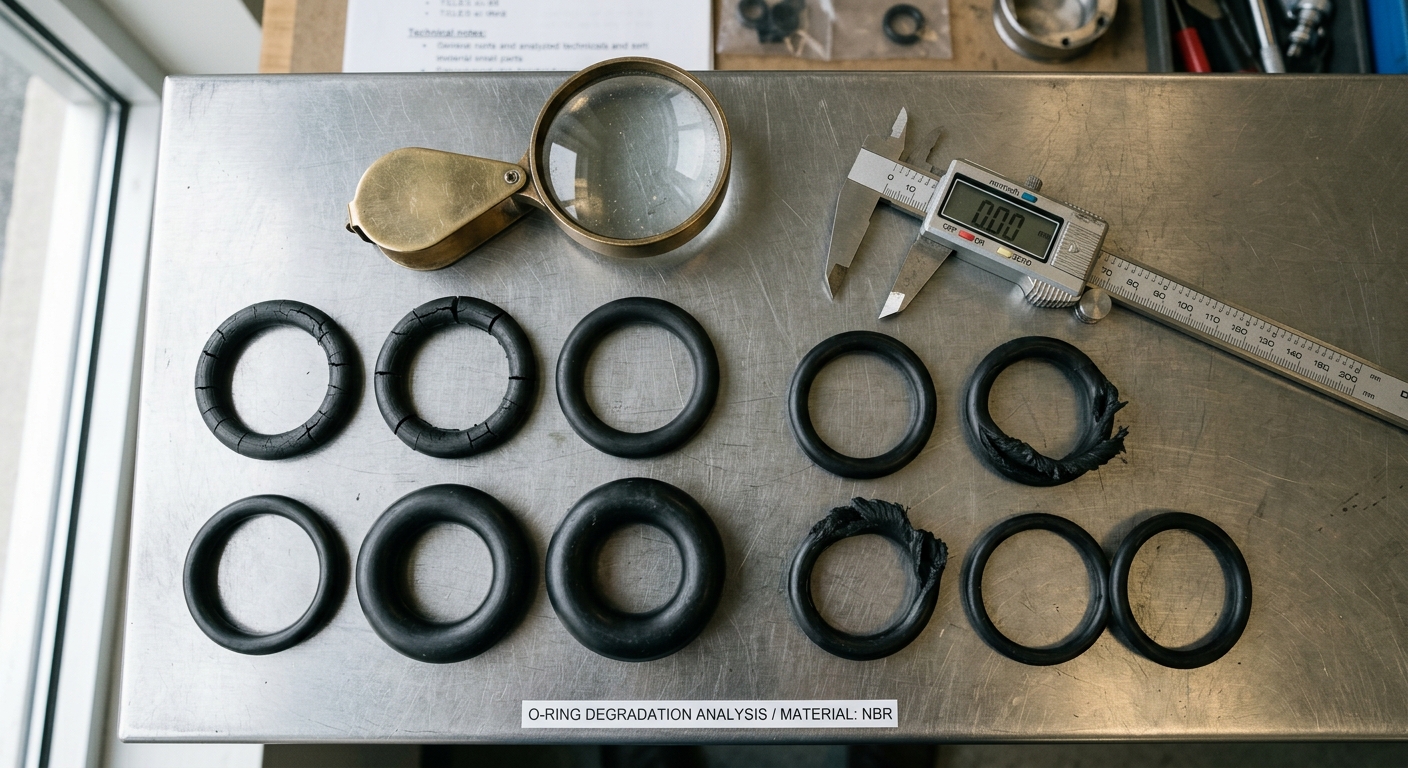
If your rubber O-rings keep failing, the cause is rarely the rubber itself — it's almost always a mismatch between material, gland design, media, or installation practice. In our experience auditing returned parts for OEM customers, more than 80% of premature O-ring failures trace back to seven recurring mistakes, most of which are fixable on the drawing board. Below, we walk through each one with the failure signatures to look for and the design decisions that prevent them.
NBR in hot brake fluid. EPDM in mineral oil. Silicone next to gasoline. These pairings still show up on drawings every week — usually because someone picked a material once, it worked once, and the spec got copied forever.
The telltale signature is swelling beyond 15% volume change, surface tackiness, or a seal that crumbles when you pull it from the groove. Chemical attack rarely fails fast; it fails six months in, after the warranty conversation has already started.
For example, a hydraulic equipment OEM we worked with had a recurring leak in their power pack returns. The drawing called for NBR 70, but the system had been switched to a phosphate ester fluid two years earlier. A move to FKM resolved 100% of field returns. The lesson: when the fluid changes, the seal spec has to change with it.
Always cross-check the actual operating media — including additives, cleaning agents, and trace contaminants — against a current chemical compatibility chart. Our engineering team can run compatibility reviews if you're unsure.
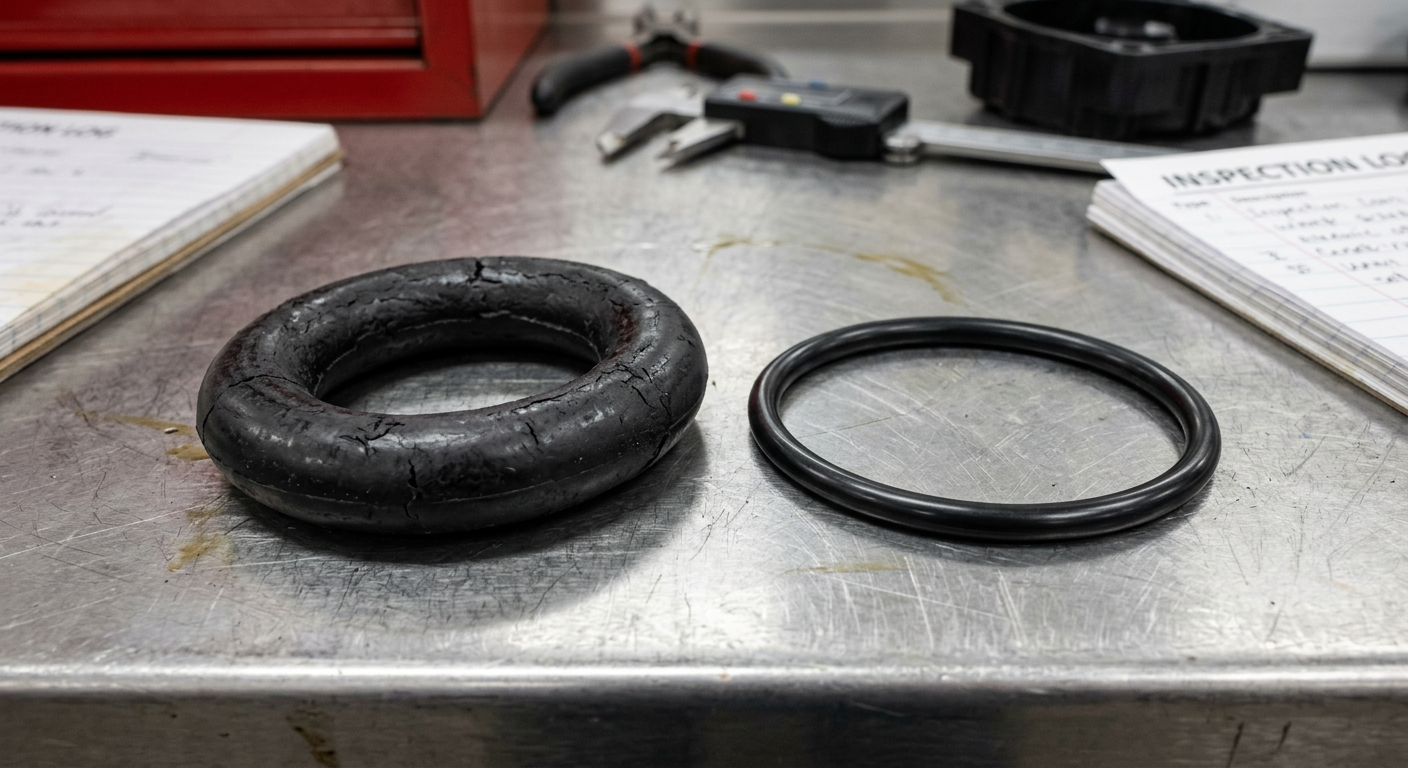
Steady-state temperature is not the number that kills O-rings. Spikes do.
A pump that runs at 90°C but sees a 160°C dead-head condition for 30 seconds during shutdown will harden NBR over time, even though 90°C is comfortably inside its range. Heat aging shows up as a glazed surface, radial cracks, and loss of elasticity — squeeze the ring, and it stays squeezed.
Rules we apply on every quote:
The cost delta between NBR and FKM is real, but the cost of a single field failure usually swallows ten years of material savings.
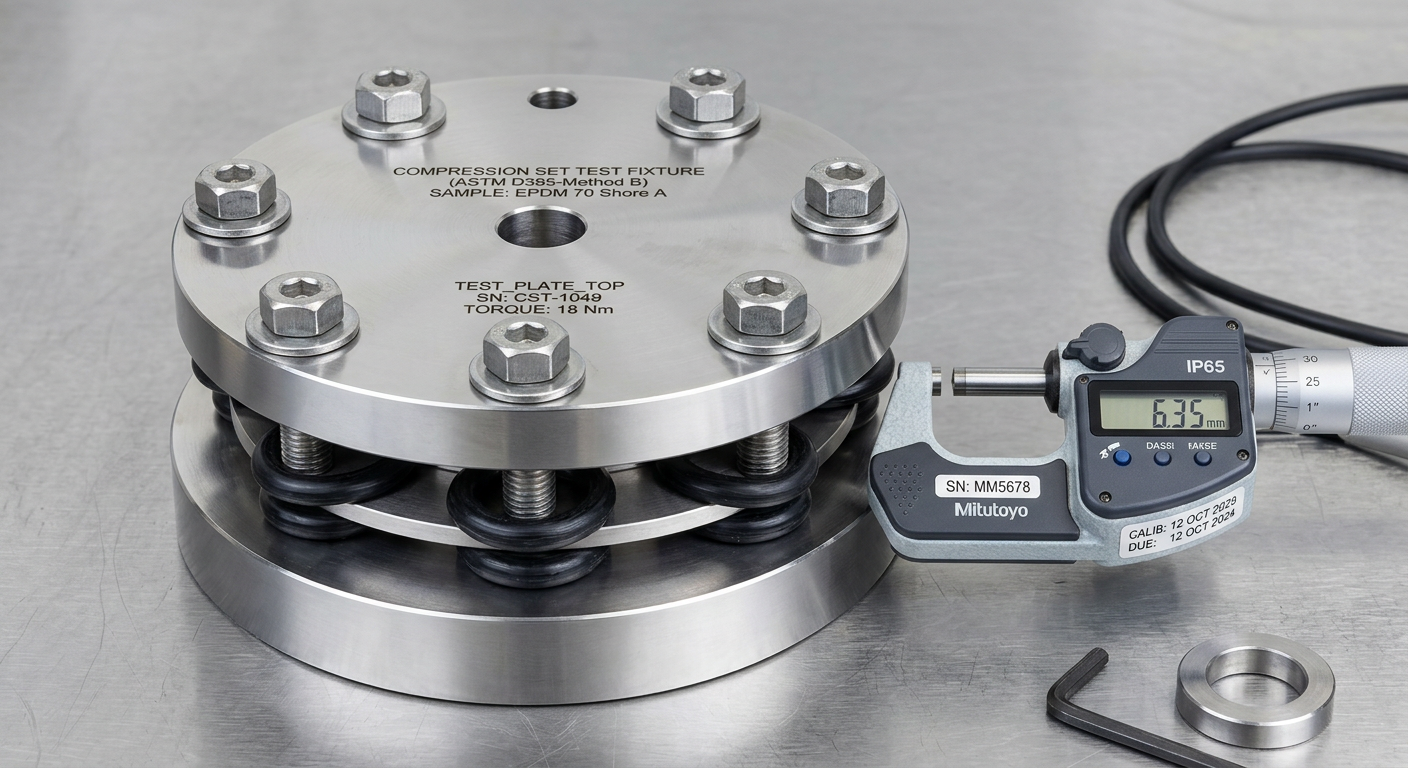
Compression set is what happens when a rubber O-ring forgets its original shape. After months under squeeze and heat, the cross-section deforms permanently — it becomes more of a flat washer than a round seal. The sealing force drops, and a slow weep begins.
You can usually catch this in incoming-goods testing. Cut a sample, measure the cross-section, hold at the rated temperature for 70 hours under 25% deflection, then re-measure. A quality peroxide-cured EPDM or HNBR should sit under 20% set. A cheap sulfur-cured compound can easily hit 40–50%.
This is also why we push back when customers ask for a cheaper compound on a long-duty application. The hardness number on the datasheet matches; the long-term behavior does not.
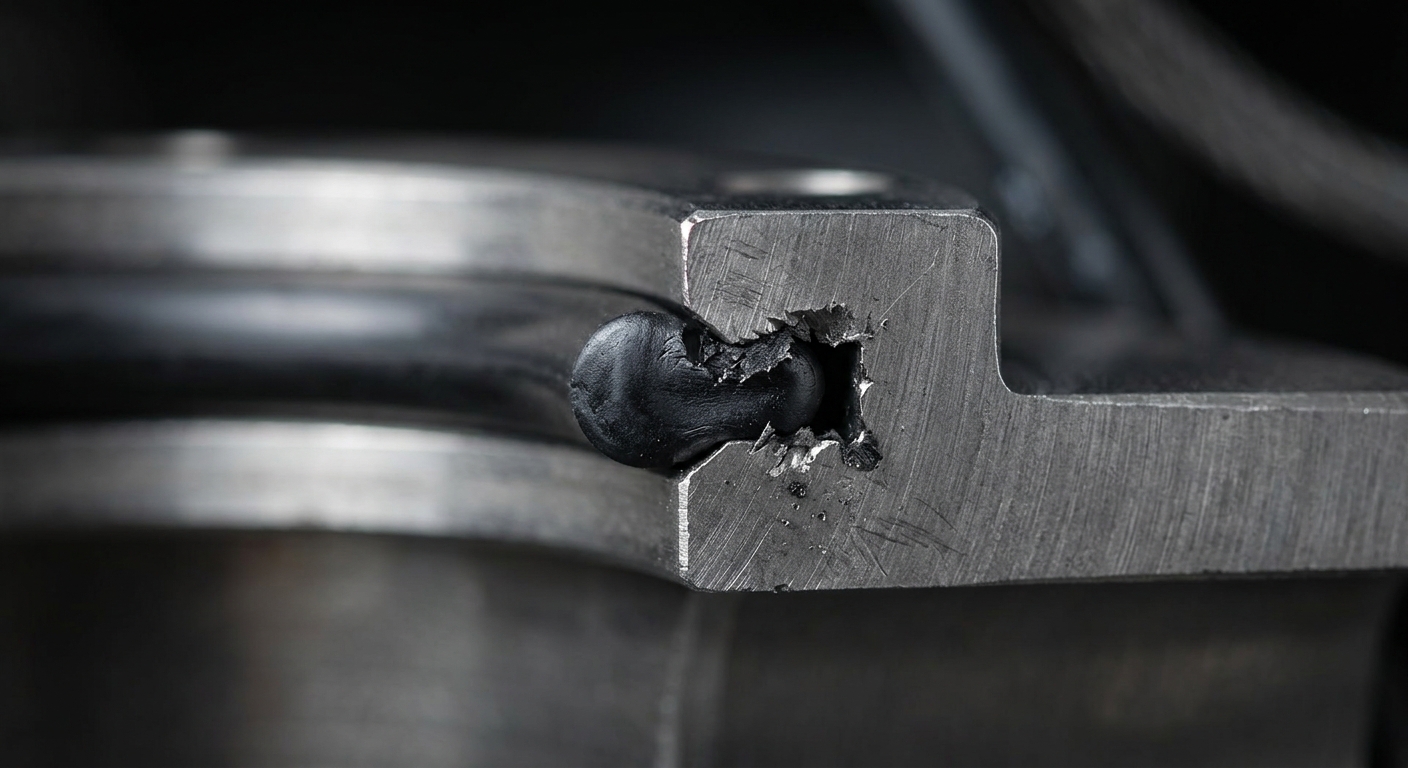
Look at a failed O-ring under a 10x loupe. If you see a thin, ragged tail of rubber peeling off one edge — that's extrusion. The pressurized side of the ring is being pushed into the gap between the gland faces.
The fix is geometric, not material:
A hydraulic cylinder builder we supply had been blaming the rubber for years. The real issue was a worn rod gland with 0.18 mm clearance. New glands plus a 90 Shore A NBR with PTFE back-ups, and the seal life went from 3 months to over 2 years.
An O-ring can be ruined in five seconds at assembly and still pass visual inspection. Thread starts, sharp groove edges, port chamfers under 15°, and missing assembly lube are the usual culprits.
The damage looks like a single clean cut across the ring's outer diameter, a spiral mark (twisting during install on a long bore), or a small notch corresponding to a port opening. None of these are material defects — they're process defects.
What to specify on the drawing:
If your assembly line can't reliably install a ring without damage, talk to your supplier about pre-lubed or pre-greased packaging. We do this for several medical device customers where line speed matters more than the per-piece cost.
70 Shore A is the default for almost every catalog O-ring. That doesn't mean it's right for your application.
Soft compounds (50–60 Shore A) seal better on rough or low-pressure surfaces — think plastic housings, sheet metal flanges, low-clamp-load designs. But they extrude easily and don't survive dynamic motion well.
Hard compounds (80–90 Shore A) resist extrusion and wear in dynamic and high-pressure service, but they need finer surface finishes (Ra ≤ 0.8 µm on dynamic surfaces) and tighter dimensional control to actually seal.
A drinking water valve manufacturer we serve switched from 70 EPDM to 80 EPDM after pressure-cycle testing showed micro-leakage at peak pulses. Same compound family, different durometer — and the issue closed out. Hardness is a design variable, not a default.
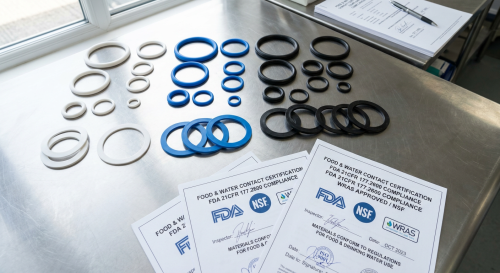
This one is uncomfortable but real. “FKM” rings on the open market are sometimes blended down with cheaper elastomers. “EPDM” rings can be sulfur-cured when the application demands peroxide-cured. “Food-grade silicone” can lack any actual FDA, WRAS, or NSF documentation.
The failure mode looks like premature anything — early swelling, early hardening, early set — that doesn't match the published curves for the named material. The root cause is that the material was never what the label said.
Three habits protect you:
On our side, every batch leaves the factory with a documented compound ID and cure record. Buyers can review our approach on the About Us page or request lot-level traceability with their order.
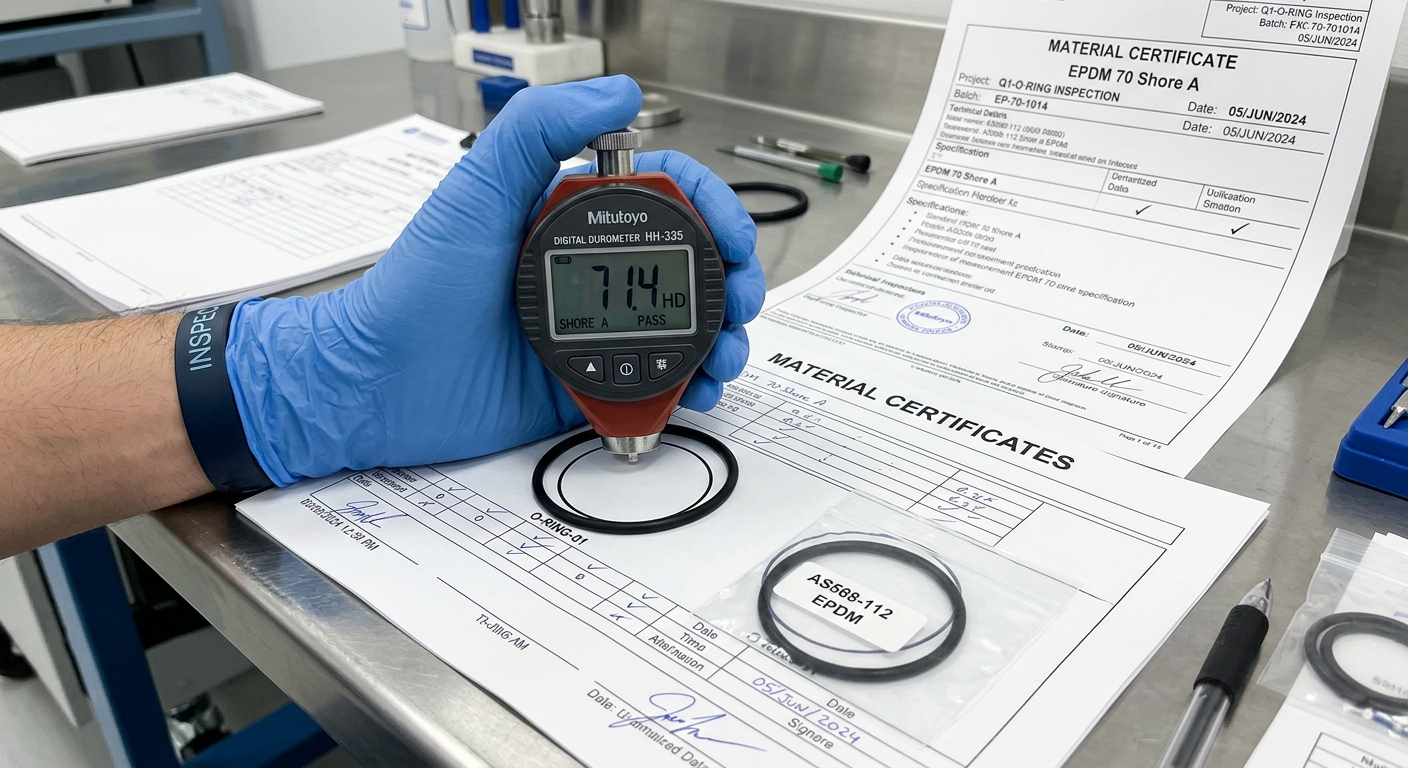
When you've narrowed down which root cause is driving your failures, the next question is usually: which material should I switch to? Use the comparison table above as a starting point, then validate with a real compatibility test against your actual fluid and temperature profile. Datasheets are a guide; bench tests are the truth.
If you want help short-listing materials for a specific application, send us the operating conditions — fluid, temperature range, pressure, motion type, and any regulatory requirements — and we'll come back with two or three viable compounds and the trade-offs between them.
O-ring failure is almost never a mystery once you have the failed part in hand. The seven causes above — chemical attack, thermal aging, compression set, extrusion, install damage, wrong hardness, and out-of-spec material — cover the overwhelming majority of what we see in the field. Most are designed in, not manufactured in, which means most are fixable before the first prototype.
If you're chasing a recurring sealing problem, the fastest path forward is usually a short design review: drawing, operating conditions, and a sample of the failed ring. Our team is happy to help — reach out through Contact Us, or browse our standard and custom O-ring options to see what we manufacture day-to-day.


English

French

German

Spanish
Our engineering team reviews your specs and responds within 24 hours with material recommendations and competitive pricing.